11 Steps: How to Align Garage Door Sensors (Quick and Easy)

Explore our latest guides and tips designed to help you stay informed and make smarter decisions.

11 Steps: How to Align Garage Door Sensors (Quick and Easy)

Explore our latest guides and tips designed to help you stay informed and make smarter decisions.

Introduction

The sensors in your garage door are a critical safety feature, working to ensure that it opens and closes properly. If your garage door fails to close properly or sounds odd when coming down, the sensors may be causing the problem. Here are 11 instructions that will help you to success in aligning garage door sensors quickly and easily.

Introduction

The sensors in your garage door are a critical safety feature, working to ensure that it opens and closes properly. If your garage door fails to close properly or sounds odd when coming down, the sensors may be causing the problem. Here are 11 instructions that will help you to success in aligning garage door sensors quickly and easily.

Step 1:Understand the Basics

To properly align your garage door sensors, the last thing you need to do is to get familiar with what garage door sensors really are and how they  perate. These sensors are normally situated on each side of the garage door close to the ground. As the door is closing, a beam of invisible light is sent across the opening for safety purposes. When this beam is cut off by anything, the sensors signal for the door to stop and reverse instead of just coming down onto some hapless individual who happens along at that moment.
IMPROVED INTERIOR LIGHTING 1259 x 795 px 1252 x 707 px 28

Step 2: Identify the Issue

 Start by testing whether or not misalignment is in fact the source of trouble. Check if the lights on both sensors are flashing or one of them is off.

Step 3: Check for Obstructions

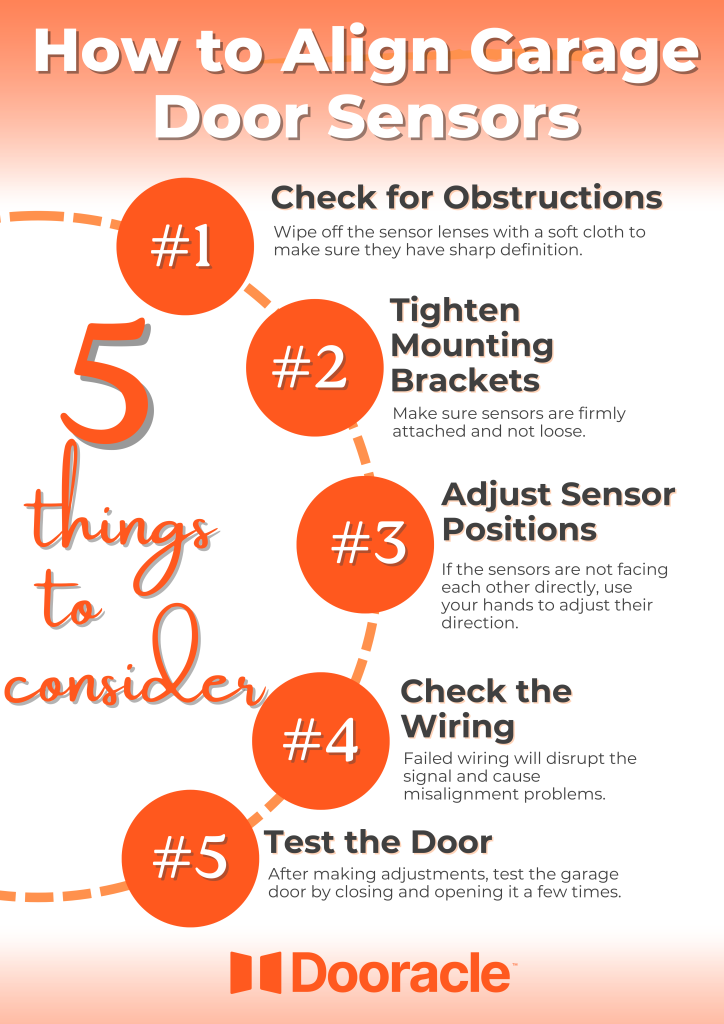
Look around the sensor lens for anything that could be causing a problem, like leaves, dirt, or a web from spiders. Objects this small can affect how well your sensors work. Wipe off the sensor lenses with a soft cloth to make sure they have sharp definition.

Step 4: Tighten the Mounting Brackets

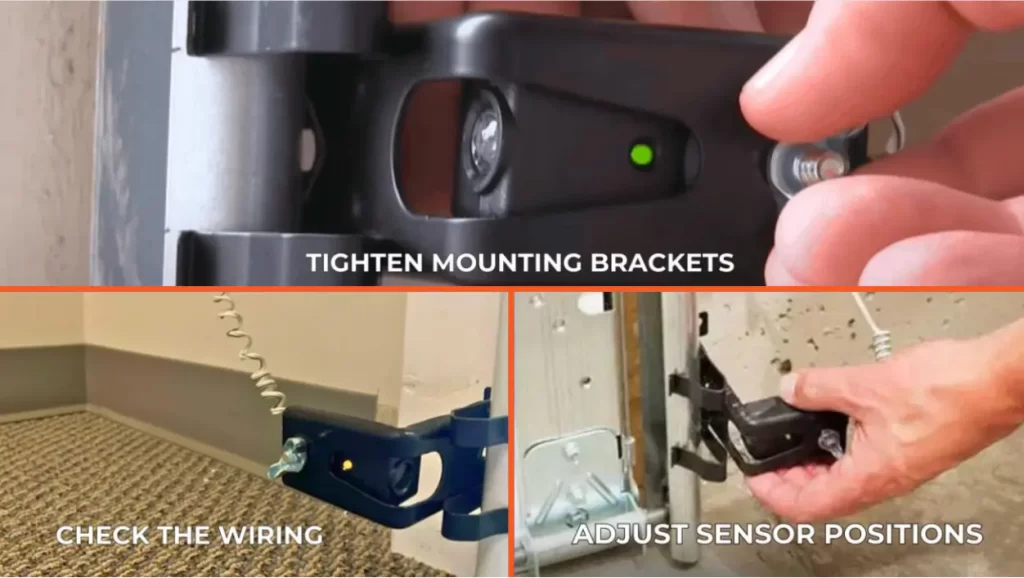
If screws are not fastened well enough and your brackets get slack mounting it may result in sensor misalignment. You should take a screwdriver using this opportunity to tighten bracket onto the wall firmly. Make sure sensors are firmly attached and not loose.

Step 5: Adjust the Sensor Positions

If the sensors are not facing each other directly, use your hands to adjust their direction. In perfectly aligned position, a beam will travel smoothly from one sensor through the other. It may be necessary to adjust the sensors’ positions very slightly with respect to one another.

Step 6: Use a Level

To make sure the sensors are at the same altitude and facing directly towards each other horizontally, use a level. Different heights may cause  constraints on how well you can see each other.

Step 7: Check the Wiring

Carefully check the wiring that connects the sensors to your garage door opener. There shouldn’t be any cuts, breaks, or exposed wires. Failed wiring will disrupt the signal and cause misalignment problems.
Step 8: Inspect for Sunlight Interference

The sensor’s beam will become disrupted by sunlight or direct glare. If the sensors are hit by direct sunlight, use a small shade to give them cover. Or else alter the angle slightly to minimize it.

Step 9: Test the Door

After making adjustments, test the garage door by closing and opening it a few times. See, if Problems observe it move smoothly without any interruptions. Or more adjustments occasionally may be needed.

Step 10: Consult the User Manual

If you still have trouble, refer to your garage door opener’s user manual.The manual often contains troubleshooting information specific to your
model.

Step 11: Seek Professional Assistance

Time to bring in the experts after all. Garage door professionals can diagnose and fix even complicated alignment issues. You won’t regret it if you need professional assistance.

Conclusion:

By following these 11 steps, you can quickly and easily align your garage door sensors, ensuring the smooth and safe operation of your garage door. Regular maintenance and occasional checks will help stave off any trouble on future alignments for a little while longer.
IMPROVED INTERIOR LIGHTING 1259 x 795 px 1252 x 707 px 29

Contact Us

Should you experience any problems with your garage door while trying to manually operate it, we encourage you to call Uplift Garage. Our friendly and experienced technicians are here to help. Call us today to speak with one of our experienced technicians

More Tips and Guides

How to Safely Remove Old Garage Door Weatherstripping

This continuous weatherstripping along the perimeters of your garage door is what fills any gaps that are present, preventing drafts from coming through while keeping moisture, pests, and dust out. However, overtime weatherstripping can deteriorate, crack, or lose its effectiveness and require replacement. Removing old weather stripes can leave some space for a more efficient one to get fit, and knowing how to do this safely can help you prepare the door. In the practical guide below, Affordable Garage Door Repair helps you safely and effectively remove old garage door weatherstripping while providing tips on cleanup and preparing for a new seal to be installed.

The Environmental Impact of Insulated vs. Non Insulated Garage Doors

If you are debating between an insulated or a non-insulated garage door, the decision may seem purely practical at first but is more environmentally unfriendly. Not only are insulated garage doors more energy-efficient (and reduce the carbon footprint of your home!), but non-insulated doors can contribute to higher energy use and increased greenhouse gas emissions. Knowing how each variety impacts energy use, environmental well-being and comfort can help homeowners create an environmentally conscious decision that will benefit the earth and their bank accounts. In this guide, Affordable Garage Door Repair outlines the environmental effects of insulated and non-insulated garage doors, emphasizing both the benefits of insulation and how to better utilize it for maximum energy efficiency.

Garage Door Backup Battery

Garage doors can prove hazardous during blackouts due to a power cutoff. It’s best to have a backup battery so if the power goes out, you’re still able to open and close your garage door. However, with so many options in the market, how do you decide which backup battery is suitable for your opener? Garage Door Backup Battery Buying Guide — In this guide by Affordable Garage Door Repair, we unpack everything you need to know about the device in order to choose one that fits your needs while also covering compatibility with your garage door opener, available capacities for purchase, battery life, and other fundamentals to consider when buying a new backup battery.